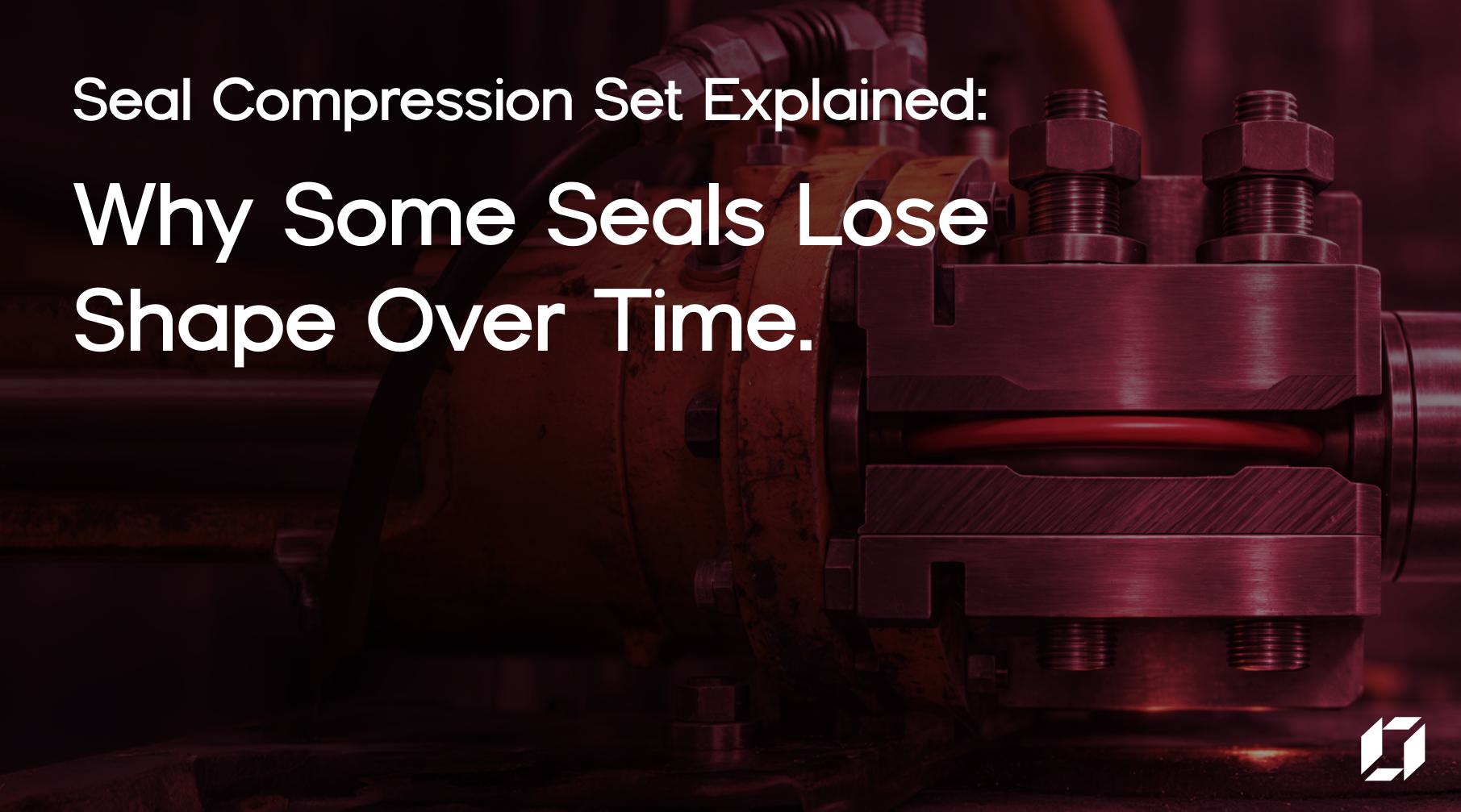
Seal Compression Set Explained: Why Some Seals Lose Shape Over Time
When a seal is installed, it is intentionally compressed. That compression creates the contact pressure required to block fluid passage. In theory, when the load is removed, the seal should spring back to its original shape. In practice, many seals do not fully recover. They remain partially flattened, losing elastic recovery and sealing force.
This permanent deformation is known as seal compression set, and it is one of the most common mechanisms behind long-term leakage in static sealing systems.
Understanding seal compression set does not require complex laboratory theory. At its core, it is about how materials behave under sustained load, temperature, and time—and how that behaviour gradually reduces sealing force.
What Is Seal Compression Set?
Compression set is the permanent deformation remaining after a material has been compressed for a period of time and then released. It is typically measured according to standardized test methods such as ASTM D395 or ISO 815, which define how long and at what temperature a specimen is compressed before recovery is measured. In a practical sealing context:
- A seal is squeezed between two surfaces.
- It remains under compression for months or years.
- Over time, the material relaxes and undergoes irreversible changes.
- When load is removed—or when thermal cycling reduces squeeze—the seal does not fully recover its original thickness.
The result is reduced contact pressure and increased risk of leakage.
A compression set is not a sudden failure mode. It is a slow degradation of sealing force.
Why Do Seals Permanently Deform?
An elastic material stores energy when deformed and releases it when the load is removed. Under sustained compression:
- Polymer chains rearrange.
- Crosslinks experience stress relaxation.
- Molecular segments gradually shift toward lower-energy configurations.
- Some deformation becomes irreversible.
This process is often described as stress relaxation combined with creep where a material continues to deform over time while the applied force remains constant, both well-documented in polymer physics literature. Over time, the internal restoring force decreases. Even if the seal still looks intact, its ability to push back against mating surfaces diminishes.
Temperature accelerates this process. Higher temperatures increase molecular mobility, which increases the rate of permanent set formation. That is why compression set testing is typically performed at elevated temperatures.
Seal Compression Set And Leakage: The Practical Mechanism
A seal prevents leakage by maintaining sufficient contact pressure at the interface between itself and the mating surface.
When seal compression set increases:
- The seal loses height.
- Contact pressure drops.
- Surface imperfections are no longer compensated.
- Micro-gaps form.
- Leakage begins along the path of least resistance.
Unlike material tearing or extrusion, compression set failure is subtle. There may be no visible damage. The seal simply cannot maintain force.
In flange joints, O-rings, gaskets, and static face seals, this is one of the most common long-term leakage mechanisms.
The Role Of Time, Temperature, And Squeeze
Seal compression set is strongly influenced by three main operating variables:
1.Duration Of Load
The longer a seal remains compressed, the greater the risk of permanent deformation. Even at moderate temperatures, time-dependent molecular rearrangement occurs.
Research on elastomer creep and relaxation shows that deformation progresses logarithmically over time. This means most deformation occurs early, but measurable changes continue for extended durations.
2.Temperature
Temperature has the largest accelerating effect.
- Elevated temperature increases chain mobility.
- Oxidative reactions may occur.
- Crosslink density can change.
- Thermal aging stiffens or embrittles elastomers.
Studies in polymer aging consistently show that higher temperatures dramatically increase compression set values. A seal that performs well at 25°C may lose recovery rapidly at 100°C.
3.Initial Compression
Seals must be compressed enough to create adequate sealing pressure. However:
- Excessive squeeze increases internal stress.
- High strain accelerates stress relaxation.
- High compression can promote microstructural damage.
Under-compression causes leakage immediately. Whereas, over-compression accelerates permanent set formation. Design is about finding the correct operating window.
Seal Compression Set vs Stress Relaxation
These two terms are related but not identical.
- Compression set measures how much permanent deformation remains after load removal.
- Stress relaxation measures how sealing force decreases while the seal is still compressed.
In real applications, stress relaxation is often the more critical failure mechanism because the seal may never be unloaded. Even without visible shape change, loss of sealing force can lead to leakage. Both phenomena arise from the same viscoelastic behavior of polymers.
Environmental Effects On Seal Compression Set
Beyond mechanical loading, environmental exposure significantly influences permanent deformation.
1.Oxidation
Oxygen diffuses into elastomers and reacts with polymer chains, especially at elevated temperature. Oxidative aging can:
- Increase stiffness.
- Reduce elongation.
- Change crosslink structure.
- Increase compression set.
2.Fluid Exposure
Swelling due to fluid absorption alters internal stress distribution. In some cases, swelling temporarily compensates for compression set. In others, it weakens the material structure.
3.Thermal Cycling
Repeated heating and cooling cycles introduce differential expansion between the seal and housing. This can accelerate permanent deformation through repeated stress redistribution. These mechanisms contribute to overall seal degradation.
Material Influence On Seal Compression Set
Different elastomers exhibit significantly different resistance to permanent deformation. Key influencing factors include:
- Crosslink density- Number of bonds linking polymer chains, controlling elasticity and shape retention.
- Polymer backbone chemistry- Core molecular structure that determines heat and aging resistance.
- Filler systems- Additives that adjust stiffness and long-term deformation behavior.
- Cure system type- Crosslinking method that influences thermal stability and compression set.
Geometry And Compression Set Interaction
Seal geometry affects how compression set translates into leakage. For example:
- A thick cross-section may tolerate more permanent deformation before leakage occurs.
- A thin-section seal loses sealing force more rapidly with the same percentage of set.
- Backup rings or anti-extrusion elements may maintain positioning even if elastic recovery decreases.
Compression set does not act in isolation. It interacts with profile design, installation tolerances, and geometry. This is why compression set values from lab testing must always be interpreted within actual assembly conditions.
Installation And Assembly Effects
Improper installation can significantly accelerate seal compression set.
1.Over-Tightening
When bolts are tightened too much, the gasket gets crushed more than it should. This extra squeezing puts the material under high stress and makes it lose its shape faster over time.
2.Gland Overfill
If the groove holding an O-ring is too small, the seal gets packed in too tightly when installed. That trapped pressure increases internal stress and causes the seal to weaken and flatten more quickly.
3.Surface Finish
Rough surfaces require greater deformation to fill surface valleys, increasing localized strain. Correct gland design standards exist to balance squeeze and allow long-term elastic recovery.
How To Reduce Seal Compression Set In Practice
- Select materials appropriate for temperature- Choose elastomers whose thermal stability exceeds expected service temperatures with safety margin.
- Avoid excessive squeeze- Design compression levels within recommended ranges.
- Control operating temperature- Even small reductions in operating temperature can significantly extend sealing force retention.
- Minimize oxygen exposure- In high-temperature static environments, limiting oxygen diffusion reduces oxidative aging.
- Validate with long-term testing- Short-term compression tests do not always reflect multi-year service conditions. Long-duration stress relaxation studies provide better predictive value.
When Seal Compression Set Becomes Critical
Compression set becomes critical in:
- Static flange gaskets operating at elevated temperatures.
- Engine and automotive under-hood seals.
- Long-term hydraulic caps and plugs.
- Industrial valves exposed to constant compression.
- Electrical enclosures requiring environmental sealing over years.
In such systems, seals are rarely unloaded. Stress relaxation and permanent deformation directly reduce sealing reliability.
The Link Between Compression Set And Seal Failure
Seal compression set is one component of broader seal degradation mechanisms. While tearing, extrusion, chemical attack, and abrasion are visible and immediate, compression set is gradual and often misdiagnosed.
When a seal appears intact but leakage occurs after long service, compression set is frequently involved.
Understanding this mechanism improves failure analysis and prevents repeated field issues.
Why Material Consistency Matters
At Robusthane, semi-finished tube quality directly influences how seals resist permanent deformation. Dimensional consistency ensures predictable squeeze. Material uniformity ensures predictable viscoelastic behavior. Machinability ensures that final profile geometry does not introduce unintended stress concentrations.
Seal compression set is not only a formulation issue—it is a system issue. It depends on:
- Polymer chemistry.
- Cure quality.
- Profile design.
- Installation compression.
- Operating temperature.
- Time in service.
Controlling upstream variables improves downstream performance.
Conclusion
Seal compression set is not just a material property—it is the outcome of how a seal is designed, manufactured, installed, and operated over time.
When elastomers slowly lose their ability to spring back, sealing force drops, contact pressure weakens, and leakage becomes inevitable. Preventing that loss requires more than selecting a compound with good lab data; it requires controlling geometry, compression levels, temperature exposure, and long-term deformation behavior in real service conditions.
At Robusthane, this understanding shapes how semi-finished tubes are developed for seal manufacturers—with material uniformity and precision that allow seal designers to manage compression set before it becomes a field failure.