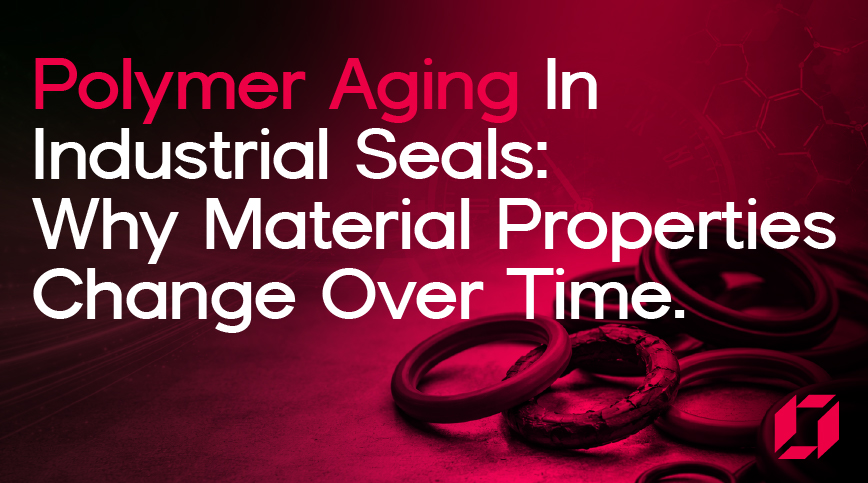
Polymer Aging In Industrial Seals: Why Material Properties Change Over Time
Industrial seals are expected to perform reliably over long periods, often in demanding environments involving heat, pressure, and chemical exposure. However, unlike metals, the materials used in seals, primarily polymers, do not remain unchanged over time.
This process, known as polymer aging, is gradual but inevitable. It does not typically cause immediate failure. Instead, it slowly alters the material’s internal structure, reducing its ability to perform its most critical function: maintaining its shape. Understanding why this happens is essential for designing sealing systems that remain effective throughout their service life.
What Is Polymer Aging?
Polymer aging refers to the time-dependent change in material properties caused by environmental and operating conditions.
Unlike wear, which results from motion and friction, aging occurs due to chemical and physical changes within the material itself. These changes affect how the polymer chains behave, which in turn alters the mechanical properties of the seal.
As aging progresses, seals tend to lose elasticity, become stiffer, and show signs of surface degradation. The most important consequence is a reduction in elastic recovery which is the ability of the seal to return to its original shape after being compressed.
Since sealing depends on maintaining continuous contact pressure, any loss in recovery directly affects performance.
Why Aging Matters In Sealing Systems
Seals work because they are slightly compressed during installation. This compression creates an initial contact force. In many systems, especially hydraulic ones, operating pressure further enhances sealing by energizing the seal against the surface.
For this mechanism to work consistently, the material must retain its ability to deform and recover. As polymers age, this ability declines. The seal may not fully rebound after compression, resulting in reduced contact pressure. Over time, this creates pathways for leakage. What begins as a material-level change gradually becomes a functional problem within the system.
This is a key part of broader seal material failure mechanisms, where aging plays a central role in long-term degradation.
Oxidation: A Primary Driver Of Aging
Oxidation is one of the most significant causes of polymer aging.
It occurs when oxygen reacts with the polymer, especially at elevated temperatures. These reactions alter the structure of polymer chains, either by breaking them or by creating additional cross-links between them.
Both outcomes change how the material behaves. Broken chains can weaken the material, while excessive cross-linking tends to make it harder and less flexible.
In seals, oxidation commonly leads to hardening and surface cracking. As the material stiffens, its ability to maintain effective contact pressure reduces. Although this process is gradual, it is continuous and accelerates in the presence of heat.
Thermal Effects And Temperature Cycling
Temperature has a direct influence on how quickly polymers age.
At higher temperatures, chemical reactions such as oxidation occur more rapidly. Even in the absence of oxygen, prolonged heat exposure can change the internal structure of the material, making it stiffer over time.In many industrial systems, seals are also exposed to thermal cycling, where temperatures repeatedly rise and fall. This causes the material to expand and contract continuously, introducing internal stress. Over time, this contributes to fatigue and loss of elasticity.
The result is a gradual decline in the seal’s ability to adapt to surfaces and maintain a consistent sealing force. This is why understanding temperature effects on seals is essential during design.
Chemical Exposure And Material Interaction
Seals often operate in direct contact with fluids such as oils, fuels, and process chemicals. These substances can interact with the polymer in ways that alter its structure and properties.
Some chemicals penetrate the material, causing it to swell. Others may extract components from the polymer or initiate chemical breakdown. Depending on the interaction, the material may soften, harden, or lose dimensional stability.
These changes affect how the seal fits within its groove and how effectively it maintains contact pressure. Over time, even small shifts in material behavior can compromise sealing performance.
For this reason, material compatibility is not just a selection step but a long-term reliability decision.
UV Exposure: Surface Degradation Over Time
Ultraviolet radiation primarily affects seals exposed to sunlight or outdoor environments.
UV energy breaks down polymer chains at the surface, leading to visible degradation such as discoloration and cracking. While this damage begins at the surface, it can gradually progress deeper into the material.
In applications where seals are exposed to outdoor conditions, UV resistance becomes an important factor in maintaining long-term performance.
Aging Is A Combined Effect
In real-world applications, polymer aging rarely results from a single factor. Seals are often exposed to multiple conditions simultaneously—heat, oxygen, chemicals, and mechanical stress.
These factors interact and can accelerate degradation beyond what any one factor would cause on its own. This combined effect makes it essential to evaluate the full operating environment when designing sealing systems.
A material that performs well under one condition may degrade quickly when multiple stresses are present.
The Impact On Sealing Performance
The most critical effect of polymer aging is the loss of sealing force.
As elasticity declines, the seal can no longer maintain consistent contact with mating surfaces. This leads to the formation of micro-gaps, increasing the likelihood of leakage. In dynamic systems, increased stiffness can also raise friction, further affecting efficiency and wear.
Over time, these changes transition from material-level degradation to system-level failure.
Designing For Long-Term Performance
Polymer aging cannot be eliminated, but it can be managed through informed design.
Material selection must account for the full range of operating conditions, including temperature, chemical exposure, and environmental factors. At the same time, groove design and compression levels must ensure that the material is not overstressed, as excessive compression can accelerate aging.
Long-term performance depends on aligning these variables rather than optimizing them in isolation.
Conclusion
Polymer aging is an inherent characteristic of sealing materials. Over time, exposure to heat, oxygen, UV radiation, and chemicals alters the internal structure of polymers, reducing their elasticity and sealing capability.
For sealing systems, this means performance is not fixed—it evolves.
At Robusthane, sealing is approached with this lifecycle in mind. By selecting materials based on real operating conditions and understanding how they will age over time, sealing solutions are designed for sustained performance and not just initial effectiveness.
Because in industrial applications, the true measure of a seal is not how it performs when new, but how reliably it continues to perform as it ages.